
Cowboy Kitsch
The surreal Wild West nonsense of video game CHAMBERS and experimental album WIDE OPEN SPACES

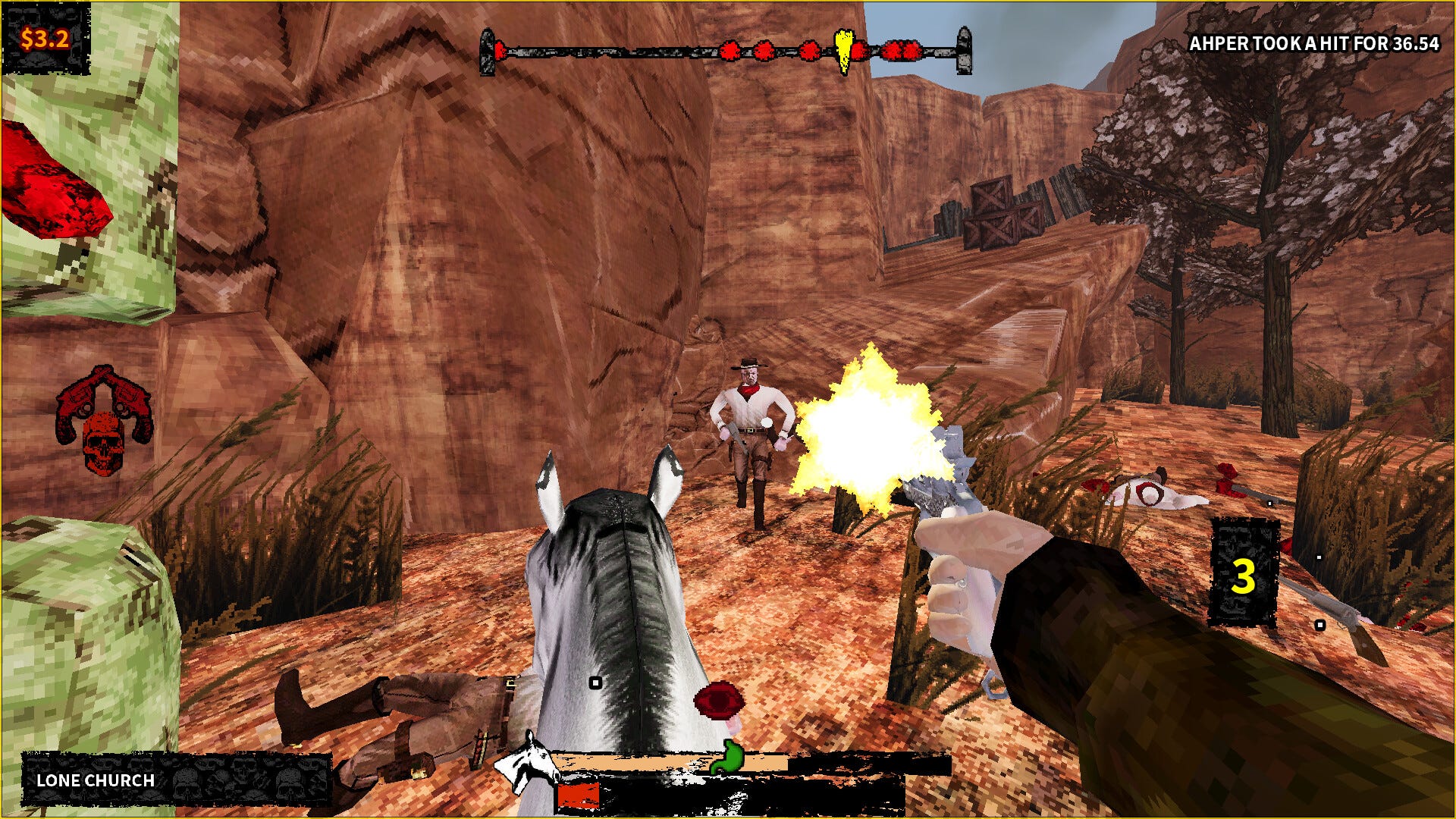
At the menu of Chamber’s early access build, a gunslinger hero — the player character — sits in a wooden coffin stacked atop a heap of another two dozen. Bodies are strewn about like litter. A murder-spree of this magnitude would be quite the notorious event in real life — in videogame land? Fairly standard.
The Wild West here smacks of straight camp: the “heh!” “ho!” jump noises; a cowboy strumming his guitar with a revolver; the UI detail of a goateed mouth chewing tobacco with macho vigour. I can catch bullets by pinching them out of the air; become invincible by making a tumbling dodge forward that the camera follows as though attached to a rolling barrel. “We had some girls here before, but they all died out,” an old-timer informs me, sitting proudly in front of a honky-tonk in the open desert air.
Chambers’ open world is not Red Dead Redemption’s earnest tribute to the Western genre, with characters whose personal codes can be understood in relation to their environment. Rather, it’s an ultra-gamey, fifth-hand pastiche of a pastiche, inhabited by zany shooting-gallery cutouts that run along their tracks according to their own hermetic logic. Leaning into systems over narrative — reputation, trading, bounties — its emergent flavour is disorienting and messy. When its automatons speak, they stutter repeated staccato syllables, as though signs and meanings were themselves in the process of breaking apart.
An exemplar of this kind of aesthetic that comes to mind is Wide Open Spaces, a live experimental sample-based album recording that came of a collaboration between People Like Us, Wobbly and Matmos captured at the San Fransisco Art Institute in 2002. Armed with five samplers, four laptops, three CD players and a pedal steel guitar, the group concocted an arch plunderphonic collage of Country and Western kitsch out of archival material, a bizarre mangle of “Yipee-i-o” cattle calls, Nashville schmaltz and entertainment show chatter.
In Wide Open Spaces, as in Chambers, familiar tropes of the Old West are treated with absurdist cheek. At the album’s opening, the serene dawning of pedal steel tones is ruptured with gasps, coughs, throaty gargles and half-aborted yodels; “Hi there!” a wrangler repeats as he greets us to his ranch, samplers skipping and stuttering like broken down animatronics. On “Clawing Your Eyes out Down to Your Throat”, cartoony groans and gunshot ricochets are incorporated into a squelchy acid house beat. “Chicken Legs”, its most ridiculous track, features inane Irish diddling, a tirade in Mexican Spanish and flatulence.
But Wide Open Spaces’s fragmentation of the mythic West goes even further than its jokes, reaching unsettling notes of subverted sentimentality. “Shenandaoah” lulls the ear as a young crooner yearns for a distant land in velvety tones, but its settler’s dream is strange, uneasy one. An eerie bowed saw rendition of “Edelweiss” superimposes the Missouri scene onto the Austrian alps, as a villain barks: “Now put the rope around your neck!” Pervading it all — the white man’s mythical call to Manifest Destiny, brought home at the album’s close with the sampling of a hymn-like ballad, “Oh the place that I worship is the wide open spaces / built by the hand of the Lord.” The album’s cover image, then, is fitting: a film strip sequence of a cowboy’s feet, suspended in the air, as if being lifted up from earth into heaven.
It's this untethering of the silly corners of the settler imagination, caricatured in the interest of surreal comedy, that Chambers and Wide Open Spaces both share. As Chambers’ developers flesh out the game, will it approach anything like the record's tonal complexity, with its power to disturb us, even as we ride along, laughing?
Originally published on Issue 86 of Unwinnable Expoits.